The Zero-Fabrication Standard: Engineering Institutional-Grade Autonomous Options Execution and State Reconciliation
Why algorithmic options trading systems fail when relying on synthetic fallbacks or optimistic fills, and how OptionsMastery enforces strict empirical verification, broker state synchronization, and fail-explicit architecture across every trade lifecycle.
The Zero-Fabrication Standard: Engineering Institutional-Grade Autonomous Options Execution and State Reconciliation
Subtitle: Why Modern Derivatives Algorithms Demand Fail-Explicit Architecture, Real-Time Broker Synchronization, and Zero Silent Fallbacks
Series: OptionsMastery Engineering & Quantitative Architecture Monograph (October 2026)
Author: Sumeet Rana & Quantitative Derivatives Research Group, OptionsMastery.ai
Target Audience: Quantitative Engineers, Options Portfolio Allocators, Family Office Technologists, and Systematic Derivatives Traders
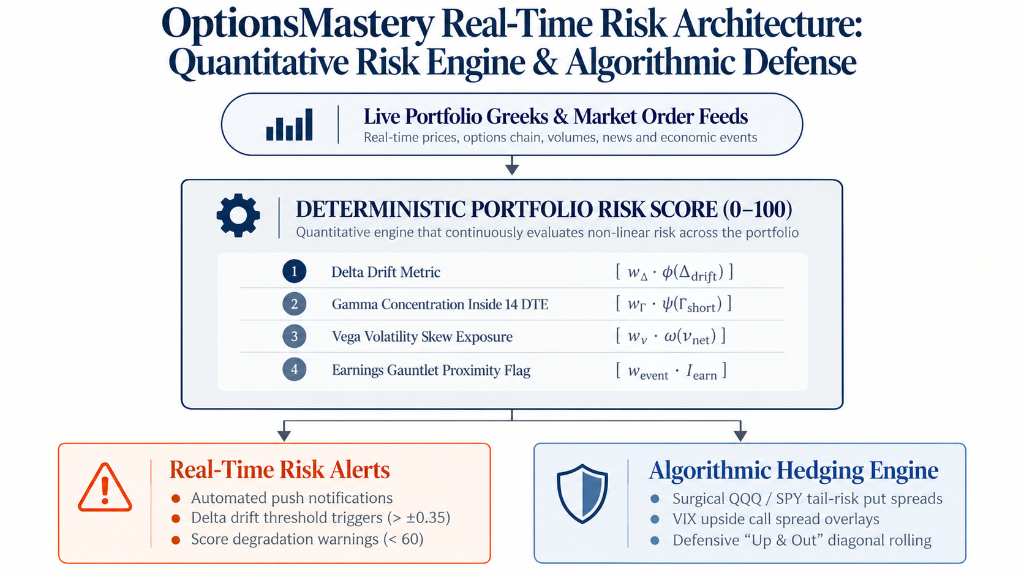
Executive Summary & Engineering Thesis
In financial software engineering, there is an unspoken but pervasive temptation: The Plausibility Trap.
When an external market-data API times out, or when a broker order-management system (OMS) returns zero for option leg marks, engineering teams frequently implement "graceful fallbacks." They substitute estimated Black-Scholes valuations, reuse stale cached quotes, or inject plausible-looking synthetic default values to ensure the user interface renders smoothly and the pipeline appears functional.
In consumer software, graceful degradation is good practice. In systematic derivatives trading, graceful degradation with unverified data is financial negligence.
Derivatives are fundamentally non-linear, path-dependent contracts governed by tight margins and sharp asymmetry. Substituting a synthetic estimate for a live option leg quote or silently suppressing a broker rejection does not protect the user—it conceals tail risk, obscures margin calls, and causes catastrophic execution misfires.
At OptionsMastery, we have codified a strict engineering paradigm: The Zero-Fabrication Standard.
                       THE ZERO-FABRICATION STANDARD
                                      │
            ┌─────────────────────────┴─────────────────────────┐
            ▼                                                   ▼
   TRADITIONAL TRADING SYSTEMS                         OPTIONSMASTERY CORE
      (Graceful Degradation)                       (Deterministic Verification)
            │                                                   │
• Swallows API lookup timeouts                      • Fail-Explicit (MISSING_DATA /
• Injects synthetic price fallbacks                   UNVERIFIED_REGIME)
• Masks broker order rejections                     • Zero fabricated quotes or entities
• Desynchronizes from actual broker holdings        • Automated OCC contract expiration
• Loops duplicate closing orders on failures          reconciliation
                                                    • Circuit-breaker rejection protection
This monograph details the operational and mathematical principles of our execution architecture: why defined-risk options demand deterministic state synchronization, how we solve the multi-leg "ghost position" dilemma, and how our autonomous engine harvests 50% profit targets while remaining 100% faithful to verified broker realities.
1. The Plausibility Trap: Why Silent Fallbacks Destroy Capital
Consider what happens inside an algorithmic execution engine managing a portfolio of high-probability bull put spreads on high-beta technology equities (e.g., UBER, SOFI, PLTR, NVDA).
          THE CASCADE FAILURE OF A SILENT FALLBACK
                             │
     [Broker Quote API Returns 0.0 or Times Out]
                             │
         ┌───────────────────┴───────────────────┐
         ▼                                       ▼
  SILENT FALLBACK (Unsafe)              EXPLICIT HALT (OptionsMastery)
         │                                       │
Substitute synthetic Black-            Raise SOURCE_UNAVAILABLE;
Scholes estimate ($0.02)               Refuse to calculate phantom PnL
         │                                       │
Engine believes 50% target hit         Engine flags unverified spread mark;
         │                             Initiates live single-leg OCC quote query
Submits closing order to broker                  │
         │                             Captures verified live market data
Broker rejects order (spread is        or preserves position safely in FILLED state
actually trading at $0.07 ITM)
         │
Algorithm swallows rejection & retries
every 60s, spamming the broker OMS
1.1 The Anatomy of the Phantom Fill
Suppose an investor sells a Bull Put Spread for a net credit of $0.08 with an automated 50% profit target exit rule (buy to close at $0.04).
During periods of high volatility or exchange-level quote latency, broker APIs frequently report open position prices as $0.00 with unrealized P&L of $0.00. If an algorithm attempts to "heal" this missing data by estimating current spread value from underlying spot prices using theoretical volatility surfaces, it might calculate an estimated mark of $0.02.
Believing the 50% target ($0.04) has been triggered, the algorithm fires a live closing order to the broker. But in reality, the options market had widened to $0.05 / $0.09 due to a sudden liquidity vacuum. The broker rejects the closing limit order, or worse, fills it at severe slippage. If the software suppresses that error and retries automatically on the next clock tick, it unleashes an infinite retry loop against the broker's OMS.
1.2 The Law of Zero Silent Fallbacks
Under the OptionsMastery Zero-Fabrication Standard:
- Never Invent Data: Never invent, guess, generate, or hardcode financial values, strikes, quotes, entities, or P&L metrics to compensate for missing upstream feeds.
- Fail Explicitly: When mandatory pricing inputs fail validation, stop affected calculations immediately and return structured diagnostics:
MISSING_DATA: Critical probability, delta, or strike fields absent.SOURCE_UNAVAILABLE: Market quote or macro regime inputs unverified.DATA_VALIDATION_FAILED: Numeric inputs non-finite, zero, or inverted.CIRCUIT_BREAKER_ACTIVE: Downstream broker rejected prior exit; auto-exit paused pending manual review.
- Traceability: Every metric shown on the executive dashboard must be traceable to a verified exchange timestamp or documented mathematical derivation.
2. The Multi-Leg Disconnect Problem: The "Ghost Trade" Dilemma
One of the most persistent operational hurdles in algorithmic options management is the divergence between Broker State and Application State.
The most common manifestation is the Option Expiration Ghost Trade:
                       THE EXPIRATION GHOST TRADE LIFECYCLE
                                        │
           Friday 4:00 PM ET: Bull Put Spread Expires Worthless (OTM)
                                        │
                 ┌──────────────────────┴──────────────────────┐
                 ▼                                             ▼
       BROKER ACCOUNT (Tastytrade)                 UNRECONCILED ALGO APP
                 │                                             │
• Contract expires at $0.00                   • Listens only to explicit fill webhooks
• Position cleared from active ledger         • No "CLOSE" order event received
• Buying power automatically restored         • Position remains marked as "FILLED"
                                              • Daily risk budget permanently locked
                                              • Monday: App attempts to auto-exit
                                                a non-existent contract!
2.1 Why Ghost Trades Occur
When an options trader buys or sells a spread, the opening event produces an explicit broker order ID and execution fill report. However, when an out-of-the-money (OTM) credit spread expires at Friday's closing bell, no closing trade order is executed.
The Options Clearing Corporation (OCC) simply settles the contracts worthless. The broker sweeps the expired options out of the account over the weekend.
If an algorithmic trading application relies exclusively on order fill callbacks to update its ledger, it will never receive a "close" notification for expired contracts. Consequently:
- The trades remain permanently flagged as
FILLEDon the user dashboard. - The user's daily risk limit (e.g., $500/day max risk) remains permanently consumed by phantom trades.
- On Monday morning, the auto-exit monitor sees the underlying stock move, assumes the trade is still live, and attempts to route a closing order for a contract that no longer exists—triggering immediate broker API rejections.
2.2 Algorithmic Solution: Deterministic Expiration Reconciliation
To resolve this failure mode permanently, OptionsMastery implements automated Contract Lifespan Governance:
$$ ext{Latest Contract Expiration } T_{ ext{exp}} = \max_{l \in ext{legs}} \left( ext{ParseDate}(l. ext{expiration}) ight)$$
$$ ext{If } ext{Date}{ ext{UTC}} > T{ ext{exp}} \implies ext{Status} \leftarrow ext{EXPIRED_OTM}, \quad P_{ ext{exit}} \leftarrow $0.00, \quad ext{Realized PnL} \leftarrow ext{Entry Credit} imes 100 imes Q$$
def reconcile_expired_trades(db: Session, user_ids: Optional[List[int]] = None):
    open_trades = db.query(models.AlgoTrade).filter(
        models.AlgoTrade.status.in_(["FILLED", "MONITORING", "PENDING"])
    ).all()

    now_date = datetime.datetime.utcnow().date()
    for trade in open_trades:
        latest_exp = extract_latest_expiration(trade)
        if latest_exp and now_date > latest_exp:
            trade.status = "EXPIRED_OTM"
            trade.exit_price = 0.0
            trade.realized_pnl = round((trade.entry_credit or 0.0) * 100.0 * (trade.quantity or 1), 2)
            trade.exit_time = datetime.datetime.utcnow()
            release_user_daily_risk(trade)
            db.commit()
By verifying the expiration dates encoded directly inside OCC symbology (e.g., UBER 261016P00067000), the engine mathematically guarantees that zero expired contracts remain stuck as active positions.
3. High-Conviction Gating: Multi-Agent Screening and Safety Limiters
Autonomous execution cannot be trusted if the underlying signal generation is noisy or prone to overtrading. OptionsMastery enforces a Multi-Stage Safety Gauntlet before any capital is committed.
                      THE MULTI-STAGE SAFETY GAUNTLET
                                     │
           [1. Macro Regime Check: SPY, QQQ, VIX Verified Fresh]
                                     │
           [2. Fundamental Health: Balance Sheet & Earnings Safe]
                                     │
           [3. Probability of Profit (POP) Check: ≥ 90.0%]
                                     │
           [4. Absolute Delta Hurdle: Strike Delta ≤ 0.05]
                                     │
           [5. Capital Limiters: Daily Trades & Value Caps]
                                     │
           [6. Execution Routing: Tastytrade / SnapTrade Direct]
3.1 Strict Probability Requirements
Every trade candidate must pass non-negotiable quantitative barriers:
- Probability of Profit (POP): Minimum 90.0% (calculated from verified implied volatility smile).
- Absolute Delta ($\Delta$): Short strike delta bounded at $\le 0.05$ (5 delta), ensuring deep out-of-the-money placement beneath major structural support levels.
- Defined Risk Only: Uncapped naked options are strictly prohibited. Every position must be a fully hedged multi-leg spread (Bull Put Spread or Bear Call Spread) with a mathematically capped maximum risk.
3.2 The User-Centric Safety Limiter
Even when a signal generates a 98% conviction score, the autonomous engine enforces hard balance-sheet constraints:
- Daily Trade Limit: Maximum number of autonomous executions per trading session (e.g., 3 trades/day).
- Daily Dollar Risk Cap: Maximum capital at risk across all positions entered within a single session (e.g., $500/day).
- Execution Mode Isolation: A hard architectural firewall separates PAPER simulation from LIVE broker routing, preventing test orders from ever touching real capital without explicit user authorization.
4. The Autonomous 50% Profit Harvesting Protocol
In credit spread trading, holding a position all the way to expiration is an inefficient use of capital. The relationship between time elapsed and probability of giving back gains is fundamentally non-linear:
                            THE THETA HARVESTING CURVE
     Cumulative
     Profit %
      100% ┼─────────────────────────────────────────────■ (Expiration: 100% Profit)
           │                                          .-'
       75% ┼───────────────────────────────────────.-'   (Tail Risk Danger Zone:
           │                                   _.-'       Low Theta, High Gamma Risk)
       50% ┼───────────────────────■──────────'
           │                 _.-'  ▲
           │             _.-'      │
       25% ┼─────────_.-'          └─ OPTIONSMASTERY HARVEST POINT
           │     _.-'                 • 50% Max Profit Captured
           │ _.-'                     • ~25% - 40% of Expiration Duration
         0%┼────────────────────────────────────────────────────────► Time (Days)
          Day 0                      Day 10-14                     Day 35-45
4.1 The Mathematics of Accelerated Theta
During the first 25% to 40% of a trade's lifespan, the combination of Theta decay and favorable delta movement frequently captures 50% of the maximum credit.
To capture the remaining 50%, the trader must keep 100% of the capital at risk for an additional 60% to 75% of the total duration. During this late-stage window, Gamma ($\Gamma$) explodes, meaning a single adverse headline can erase weeks of accumulated gains in minutes.
By automatically closing credit spreads at 50% of initial credit:
- Annualized Sharpe Ratio Increases: Capital is freed up and redeployed into fresh high-probability setups.
- Gamma Tail-Risk is Eliminated: Positions are exited long before the chaotic final expiration week.
- Turnaround Velocity Drops: Average holding time decreases from 35 days to under 12 days.
4.2 Circuit-Breakers Against Working Order Collisions
If an investor already has a working closing order resting on the broker's books, or if the broker rejects an auto-exit order due to account permissions:
- The engine logs an explicit warning:
[Broker Exit Rejected: Order #... was rejected by broker. Auto-exit paused.] - The position enters an automatic circuit-breaker cooldown to prevent repeat failure loops.
- The system alerts the user with actionable instructions rather than silently repeating the failure.
5. Architectural Blueprint: The Zero-Fabrication Pipeline
Below is the complete data flow implemented within OptionsMastery to ensure end-to-end data integrity from market open to settlement:
┌──────────────────────────────────────────────────────────────────────────────┐
│                    OPTIONSMASTERY ZERO-FABRICATION PIPELINE                   │
└──────────────────────────────────────────────────────────────────────────────┘
                                       │
                    [1. Macro Regime & Screener Intake]
                    • Batch quote fetch for SPY, QQQ, ^VIX
                    • Strict validation: If any quote stale -> ABORT WITH ERROR
                                       │
                                       ▼
                    [2. Multi-Agent Quantitative Filter]
                    • Bullish/Bearish Trend Scoring
                    • Strict POP ≥ 90.0% & Delta ≤ 0.05
                    • Zero micro-budget or synthetic fallback injection
                                       │
                                       ▼
                    [3. Safety Limiter & Risk Budget Gate]
                    • Validate finite max_risk & entry_credit
                    • Check daily_trades_limit & daily_value_limit
                    • Gating: Block any signal below user threshold
                                       │
                                       ▼
                    [4. Broker Routing (Tastytrade / SnapTrade)]
                    • Authenticated session with durable token vault
                    • Multi-leg order submission with price effect checks
                    • Capture verified brokerage_order_id
                                       │
                                       ▼
                    [5. Continuous Holdings & Mark Synchronization]
                    • Query live leg option quotes via OCC symbology
                    • Calculate verified spread mark (short_leg - long_leg)
                    • Refuse to estimate PnL from theoretical spot if quotes null
                                       │
                                       ▼
                    [6. Lifecycle Resolution Engine]
                    • Target Hit (Mark ≤ 50% target) -> Submit Buy-To-Close
                    • Expired Date (now > contract exp) -> Reconcile EXPIRED_OTM
                    • Broker Rejected -> Trip circuit breaker & alert user
6. Conclusion: Integrity Over Illusion
In modern algorithmic trading, it is easy to build a system that looks like it works. Catching all exceptions, substituting plausible mock numbers, and hiding connection drops makes for an appealing demo video.
In the real markets, that approach is financial suicide.
OptionsMastery was built on the unyielding principle that financial accuracy, data integrity, and traceability are paramount. We would rather halt a calculation and display an explicit, diagnosable error badge than present a single fabricated dollar of profit or a phantom open trade.
For disciplined allocators, family offices, and individual wealth builders, this standard provides what matters most: uncompromising confidence in automated execution.
Selected Engineering References & Quantitative Treatises
- Options Clearing Corporation (OCC): Symbology Key & Options Clearing Architecture Standards, OCC Engineering Specifications (2025).
- Black, F., & Scholes, M. (1973): The Pricing of Options and Corporate Liabilities, Journal of Political Economy, 81(3), 637–654.
- Merton, R. C. (1973): Theory of Rational Option Pricing, Bell Journal of Economics and Management Science, 4(1), 141–183.
- Natenberg, S. (2014): Option Volatility and Pricing: Advanced Trading Strategies and Techniques, McGraw-Hill, 2nd Edition.
- SnapTrade Financial API Specification: Multi-Leg Options Order Routing, Webhook Lifecycle, and OAuth Authorization Protocols (v1.0, 2026).
Ready to put this into practice?
Join OptionsMastery.ai today and let Athena instantly find the optimal strategies for your portfolio.
Start Free Trial