The Disciplined Path to Wealth: Constructing an Option-Enhanced Strategic Roadmap for Higher CAGR
How to combine structural index investing, systematic covered call writing, and capital-efficient LEAPs to target higher compounding rates with strict risk management.
The Disciplined Path to Wealth: Constructing an Option-Enhanced Strategic Roadmap for Higher CAGR
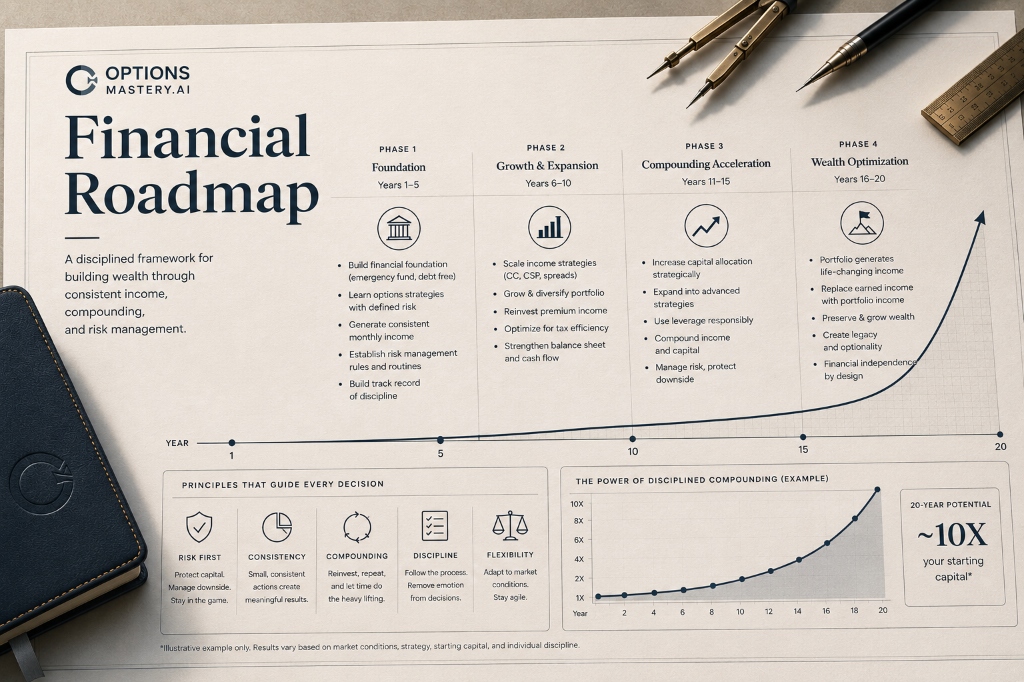
Many investors believe that achieving a higher Compound Annual Growth Rate (CAGR) automatically requires taking on higher speculative risk. They assume the only way to beat the market's historical 8-10% return is by picking high-beta individual stocks, trading short-term momentum, or buying speculative growth stories.
However, sophisticated options overlay strategies offer an alternative path: capital efficiency and premium harvesting.
By overlaying systematic options structures on top of core equity indices, you can construct a disciplined roadmap that accelerates compounding without exposing your capital to catastrophic tail risk. In this post, we’ll outline how we structure a multi-year financial roadmap and how options overlays mathematically enhance CAGR through distinct stages of wealth building.
1. The Math of Compounding: Why CAGR Matters
Compounding is the most powerful force in finance. A difference of just a few percentage points in your annualized compounding rate has a massive impact on your final wealth over a 10 to 20-year horizon.
Let's look at the mathematical difference starting with a portfolio of $1.00M over a 20-year timeline:
- At 8.0% CAGR (Passive Index Investing): $V_{20} = $1,000,000 \times (1 + 0.08)^{20} \approx $4,660,957$
- At 12.0% CAGR (Option-Enhanced Growth): $V_{20} = $1,000,000 \times (1 + 0.12)^{20} \approx $9,646,293$
- At 15.0% CAGR (Institutional Efficiency): $V_{20} = $1,000,000 \times (1 + 0.15)^{20} \approx $16,366,537$
By elevating your compounding rate from 8% to 15%, you capture over $11,700,000 in additional wealth over 20 years.
To achieve this target return, our roadmap segments the compounding path into three structured, repeatable strategic phases.
2. Phase 1: Capital Efficiency & Leverage (The Wealth Accelerator)
In the initial years of a roadmap, the goal is maximum capital efficiency. Standard retail trading relies on purchasing underlying stock at 100% margin requirements. To accelerate your CAGR in a disciplined way, we employ Poor Man's Covered Calls (PMCC) via deep-in-the-money long-dated LEAP options.
The Mechanics of the PMCC
Instead of buying 100 shares of SPY or QQQ for $50,000, you purchase a long-dated LEAP option (typically 1.5 to 2 years out) with a strike price deep-in-the-money (Delta of 0.80 or higher) for a premium of approximately $12,000.
- The Leverage Benefit: You gain the directional exposure of 100 shares of stock at a fraction of the cost, freeing up 70% of your capital.
- The Premium Overlay: You write short-term (weekly or bi-weekly) out-of-the-money calls against this LEAP position. The short call premium decays rapidly due to theta decay, yielding a consistent income stream.
- Theta Capture: By collecting weekly theta on a leveraged base, the annualized options yield adds 6% to 12% on top of the underlying asset's returns.
3. Phase 2: Systematic Yield & Credit Spreads (The Compounding Engine)
Once the portfolio scales past key milestones, the strategy shifts toward delta-neutral volatility harvesting. Instead of directional leverage, we utilize defined-risk credit spreads to capture the Volatility Risk Premium (VRP).
The Options Wheel & Credit Spreads
- Cash-Secured Puts (CSP): We sell out-of-the-money put options on high-quality index ETFs at a 30-Delta strike. If the market stays flat or rallies, we collect 100% of the premium.
- Covered Calls: If the stock drops and we are assigned the shares, we immediately write covered calls at a 30-Delta strike to generate double premiums.
- Credit Spreads: To limit capital requirements and manage risk, we convert naked short positions into credit spreads (such as Iron Condors). This defines our maximum risk while allowing us to harvest decay daily.
By utilizing high-liquidity indexes, the portfolio avoids single-stock gap risk and compounds premiums during range-bound consolidations where directional investing flatlines.
4. Phase 3: Wealth Preservation & Collateralization (Locking in the Target)
As you approach your wealth milestone (e.g. $100M), the priority shifts from wealth accumulation to preservation and downside defense. High CAGR is no longer necessary; the goal is locking in the compounded wealth.
The Protected Collar Protocol
We convert the portfolio into core index holdings and wrap them in a Protective Collar:
- Buy a Protective Put: Purchase a 10% out-of-the-money put option to define the maximum drawdown during market panic.
- Write a Covered Call: Sell a 10% out-of-the-money call option to fully fund the protective put purchase.
This creates a cost-free collar hedge. The portfolio's upside is capped at 10%, but its downside is fully protected below 10%, ensuring a major market correction cannot derail your roadmap. The remaining cash sweeps compound in safe money market instruments (yielding risk-free interest).
5. Risk Discipline: The Golden Rules
Achieving a superior CAGR is not about taking massive bets. It is about avoiding drawdowns. Options harvesters must follow three core rules:
- Maintain Cash Reserves: Always keep 10-20% of your portfolio in high-yield money market cash sweeps (e.g. SPAXX) to fund dip buying and option adjustments.
- Close at 50% Profit: Never hold short options to expiration. Lock in gains systematically when options reach 50% of their maximum credit value.
- Position Size Comfortably: Keep each individual options position under 3-5% of total account value to protect against tail-risk correlation.
6. Projecting Your Own Option-Enhanced Roadmap
At OptionsMastery.ai, we believe every long-term options program must be mathematically modeled before putting real capital on the line.
Our new Interactive Financial Roadmap dashboard allows you to define your starting portfolio value, your long-term goal, and your target years. It dynamically projects:
- The required CAGR curve.
- A side-by-side comparison of passive compounding vs. options mastery growth.
- A multi-year strategic allocation guide detailing your PMCC, credit spread, and cash sweep allocations.
- The exact start and target end value for each growth phase.
Are you ready to map out your compounding journey? Try our premium Financial Roadmap today on OptionsMastery.ai and consult with your AI strategy strategy explainers.
7. Disclaimers & Structural Risk Caveats
Before executing options overlays, you must understand their structural trade-offs:
- Leverage Risk: LEAPs provide capital efficiency but amplify downswings. A sharp market drop can lead to significant percentage drawdowns compared to standard index holdings.
- Upside Capping: Selling covered calls or collars caps your maximum upside return. In strong bull markets, your shares may be called away, causing you to underperform index buy-and-hold strategies.
- Theta Decay & Timing: Options are wasting assets. If the market stays flat or moves against your LEAPs, the contract will decay to zero over time.
- Not Financial Analysis: Projections are not guarantees. Options involve risk and are not suitable for all investors.
Ready to put this into practice?
Join OptionsMastery.ai today and let Athena instantly find the optimal strategies for your portfolio.
Start Free Trial